
The Written Version
This work is not a scientific theory. It is a symbolic cosmology — a personal language built from geometry, numbers, cycles, and ancient motifs. It explores meaning, not physics.
Neutron
The neutron occupies a unique place in the architecture of life.
Neutral, balanced between stability and transformation, it appears as the first organized form emerging from The Nothingness.
The following text presents a geometric interpretation of the neutron.
It does not seek to replace modern physics; rather, it proposes another way of understanding matter, The Void, and the structure of reality through pure geometry.
In this approach, forms are not symbols: they constitute the deep architecture of existence.
The Geometry of The Nothingness and The Void
The Nothingness is not an absence. It is the origin of form.
When The Nothingness becomes aware of itself, it adopts the simplest possible volumetric structure:
the tetrahedron.
Two orientations instantly appear:
- direct tetrahedron: +1
- inverted tetrahedron: -1
These two polarities coexist and cancel one another:
+1 + -1 = 0
Two opposite and inverted regular tetrahedra united around the same central point form a stellated octahedron, meaning that 8 tetrahedra form an octahedron: 4 positive and 4 negative. These 4 pairs of polarities cancel each other out:
+1 -1 +1 -1 +1 -1 +1 -1 = 0
Zero is The Nothingness creating The Void.
From 0 to 8, however, we obtain nine digits: the birth of 9, the first neutral space in the shape of an octahedron: The Void.
The Nothingness created The Void. It compresses it through its infinity and reduces it through successive phases — a fractalization of a neutral space that, over time, returns toward The Nothingness.
We now have two forms of time:
- the infinite present,
- and the present instant, the lifetime, life itself.
Life moves within infinite present time. Life struggles against time, gravitation, and The Nothingness, and eventually returns to The Nothingness — hence 9 = 0 in digital root, the cycle of the Big Crunch.
In this perspective, The Void is:
- a continuous oscillation,
- an invisible geometric field,
- a neutral structure,
- a present instant under suspension.
The Void has therefore been geometrically structured.
From Duality to Structure
When the two opposing tetrahedra (+1 and -1) interlock, they form:
a stellated octahedron (the classical stella octangula).
This structure contains:
8 tetrahedra.
Therefore:
- 2 opposing tetrahedra → 1 stellated octahedron
- 1 stellated octahedron → 8 tetrahedra
- 8 tetrahedra → the external architecture of the neutron
The number 8 represents the organization of matter before manifestation.
Discovery of the Neutron
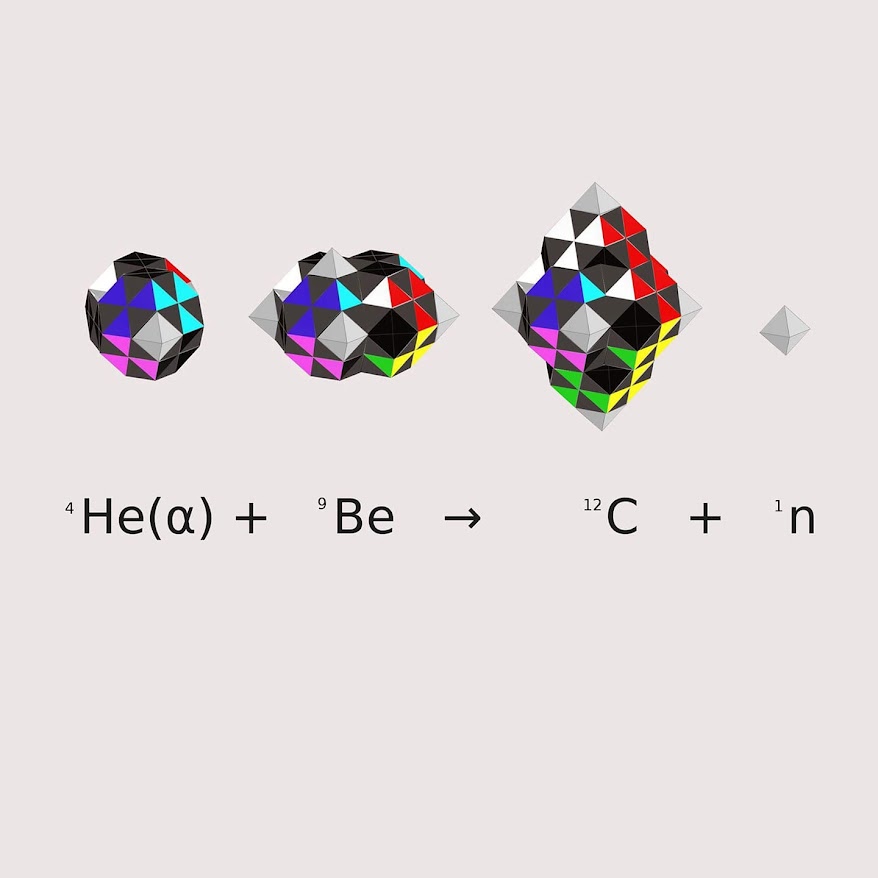
The neutron was discovered in 1932 by the British physicist James Chadwick. At that time, scientists knew that atomic nuclei contained positive charges (protons), but the total mass of many elements could not be explained by protons alone.
Chadwick investigated a mysterious radiation produced when alpha particles were directed onto beryllium. This reaction generated a new type of particle that carried no electric charge but had a mass similar to that of the proton.
The key reaction he studied was:
4He + 9Be → 12C + n
From this result, Chadwick concluded that the nucleus contained a neutral particle: the neutron.
Its discovery completed the basic structure of the atom and opened the path to modern nuclear physics.
In this geometric interpretation, the neutron corresponds to the first neutral space — the Void — emerging from The Nothingness.
Quarks and the Structure of the Void
The number 1 represents the Nothingness. The number 9 represents the neutron, the first neutral space: the Void.
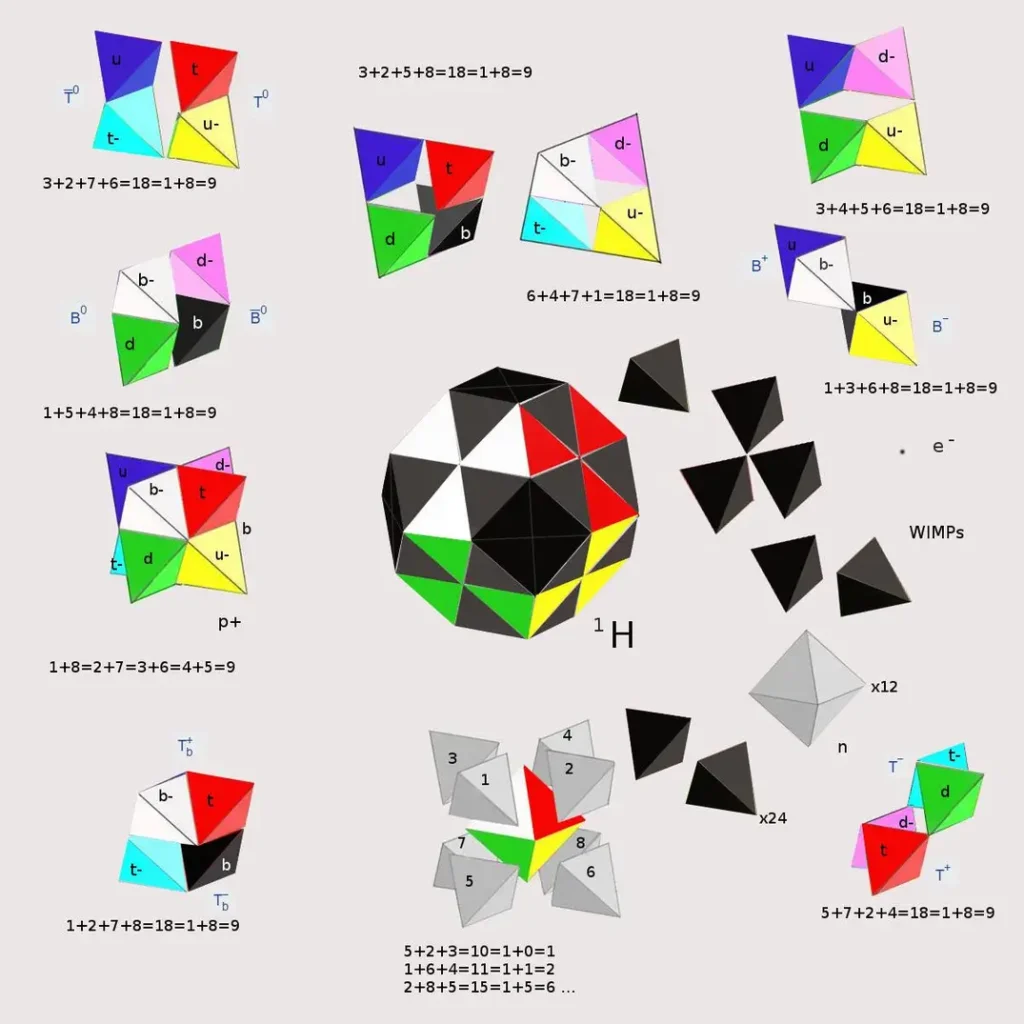
A neutron is formed from 8 quanta of Nothingness:
- 4 positive
- 4 negative
These 8 units assemble into 4 pairs. Each pair is a quark, formed by two opposite tetrahedra:
- light / darkness
- white / black
- life / death
- +1 / –1
In the diagram, there are 6 quark pairs formed from 4 quanta, corresponding to the 6 fundamental directions of an octahedron. There are 3 possible ways to assemble them into a stellated octahedron, or a neutron. These pairs are: t–u and t–u–, u–d and u–d–, d–b and b–d–, u–b and u–b–, b–t and b–t–, d–t and d–t–.
These quarks are quanta of Nothingness. They form the Void, compress it, and make it vibrate. This vibration is life. When the vibration collapses, the Void returns to the Nothingness:
9 = 0
Quark pairs resemble:
- axes of symmetry
- quantum doublets
- spin pairs
- quaternions
- SU(2) transformations
- creation/annihilation pairs
- fundamental polarities
- directions of Nothingness
- geometry generators
- vibration units
- quanta of Nothingness
From 8 to 9: Manifestation
Counting from 0 to 8 gives 9 values.
0, 1, 2, 3, 4, 5, 6, 7, 8 → 9 stages.
Therefore:
- 8 = structure
- 9 = manifestation
The neutron is the 9: the moment when structure becomes existence.
In a fractal interpretation:
9 = 0
because the end of a cycle returns to the origin.
The neutron is therefore:
- the bridge between non-being and matter,
- condensed Void, life itself.
EXternal Geometry of the Neutron
The neutron may be described as a geometric assembly:
- 1 geometric unit = 2 tetrahedra
- 4 units = 8 tetrahedra
- 8 tetrahedra = 1 octahedron
- 1 octahedron = the structure of the neutron
The neutron is therefore a compressed star-shaped octahedron.
Its neutrality comes from the balance of its internal polarities.
Compression and Singularity
When the octahedral structure contracts:
- internal distances decrease,
- tensions increase,
- geometry becomes denser.
The octahedron collapses into:
a truncated cuboctahedron. The 8 tetrahedra that formed it converge together, creating a singularity — a point where all 8 tetrahedra are in contact: the formation of the first black body (black hole).
It is truncated on each of its 6 square faces, allowing the integration of octahedra, the whole reforming the original octahedron.
We now have a black body surrounded by 6 neutral spaces: the second compression of The Void, a neutron star.
Protium: The First Stable Form
After 3 compressions of the original Void, we obtain the first black body, 6 smaller black bodies, and 36 neutral spaces — enough elements to constitute a geometric form capable of preserving a neutral space against the infinite pressure of The Nothingness and the present time.
We then obtain protium, the first stable atomic structure.
Protium corresponds to a truncated octahedron:
- 8 hexagonal faces
- 6 square faces
- 24 vertices
- 36 equal edges
This solid possesses a unique property:
it tessellates space perfectly.
Protium is therefore the first stable architecture of life: the first cosmic egg.
The Neutron as an Equation
The neutron may be expressed as a balance between two universal principles:
where:
- φ = cohesion, structure, gravitation
- α = interaction, movement, electromagnetism
The neutron is the equilibrium point between these forces.
Stability and Transformation
A free neutron is unstable:
- lifetime ≈ 880 seconds
- transformation into proton + electron + antineutrino
A bound neutron becomes stable through:
- internal compression,
- geometric equilibrium,
- structural cohesion.
The neutron is the boundary between equilibrium and transformation.
Conclusion
In this geometric vision, the neutron is not merely a particle. It is:
- a structure of The Void,
- a dynamic geometry,
- a condensation of The Nothingness,
- the first architecture of life.
Void, form, and matter become different states of the same underlying geometry.
Geometry does not describe reality.
Geometry is reality.
© 2026 ADAMS‑J‑AI — Legal Notice