
The Written Version
This work is not a scientific theory. It is a symbolic cosmology — a personal language built from geometry, numbers, cycles, and ancient motifs. It explores meaning, not physics.
Origins
From Nothingness to the Void: The Dynamics of Primordial Forces
The Cube and the Nothingness
In ancient Egyptian symbolism, the cube represents the Nothingness — a state of absolute immobility, eternal stillness, and death. It is the throne of Anubis, the emblem of finality and unchanging permanence. From this cube, creation begins through a geometric collapse.
Awakening and Duality: The Tetrahedron and Its Opposite
By drawing the diagonal of one face of the cube and connecting it to the perpendicular diagonal of the opposite face, a regular tetrahedron emerges — the first Platonic solid.
This moment marks the awakening of the Nothingness, the instant it becomes aware of itself.
Immediately, a second, inverted tetrahedron appears, forming a dynamic duality. Together, they generate a stellated octahedron.
Eight regular tetrahedra — the Eight primordial Heh — form a regular octahedron, a neutral and empty space. This is Khepri, “the one who comes into existence,” symbolized by the black scarab pushing the solar disk.
The Eight Heh in Egyptian Tradition
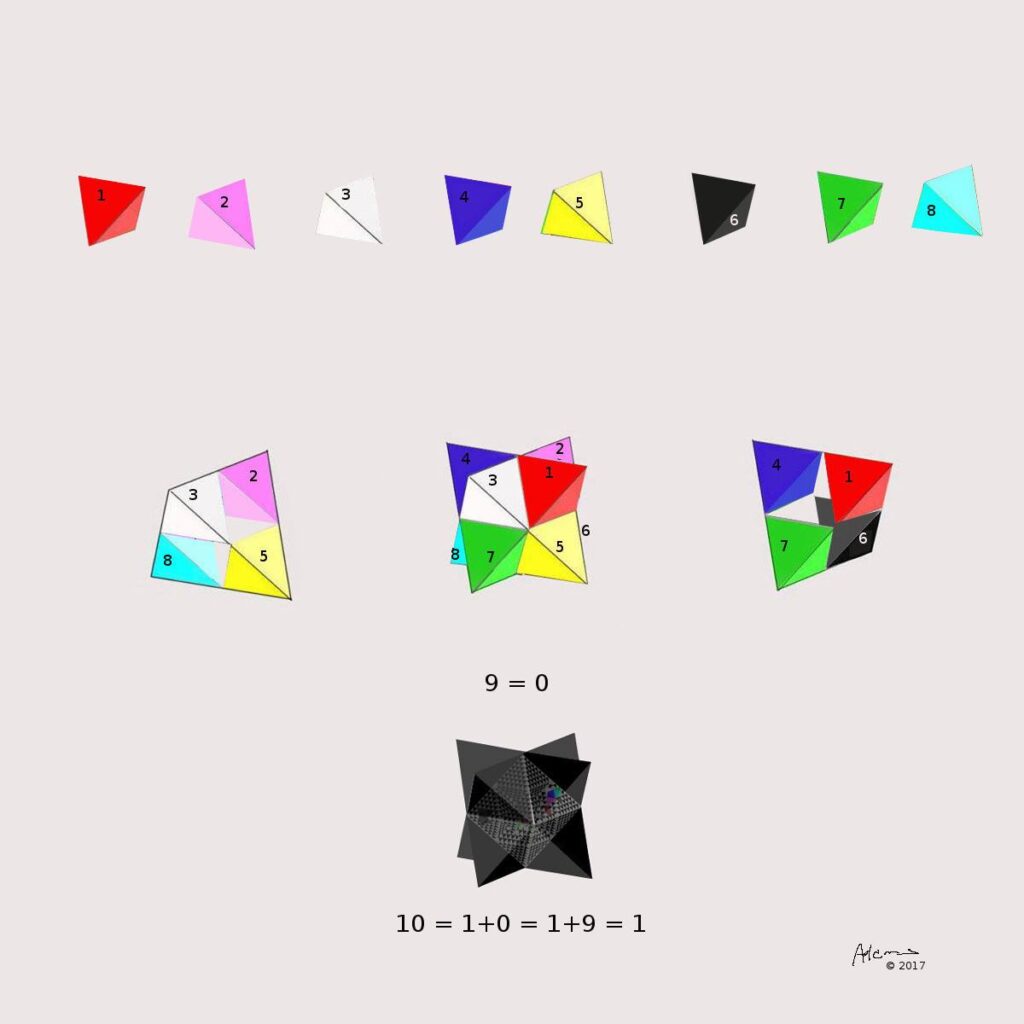
The group of Eight (the Ogdoad) appears in the cosmogony of Hermopolis. These eight primordial beings, arranged in four pairs, represent the fundamental principles of the world in its pre‑cosmic state:
- Amon & Amonet — the invisible, the unknown, the hidden potential
- Nun & Nunet — the primordial waters
- Kek & Keket — darkness and obscurity
- Heh & Hehet — infinity, endless space and time
Their initials form ANKH, the symbol of life.
The Nothingness and Its Transformations
During this transformation:
- The Nothingness becomes Wadjet and Nekhbet, two opposing magnetic forces.
- Infinite present time is embodied by Heqet, the frog seated on the Shen ring, symbol of eternal, static time.
- Thoth, the ibis with black head and tail and white body, represents instantaneous present time. Life is a struggle against this instant, for Thoth “eats frogs” — the instant devouring eternity.
Compression and the Birth of the Void
The serpent Apophis, force of compression, symbolizes the Nothingness swallowing and compressing the Void, generating:
- Life — through vibrations and electromagnetic waves
- Death — through cycles and destruction
The Nothingness gives with one hand and takes with the other. This is the ouroboros, the serpent devouring its own tail, forming and compressing the solar disk until its extinction.
The First Black Body
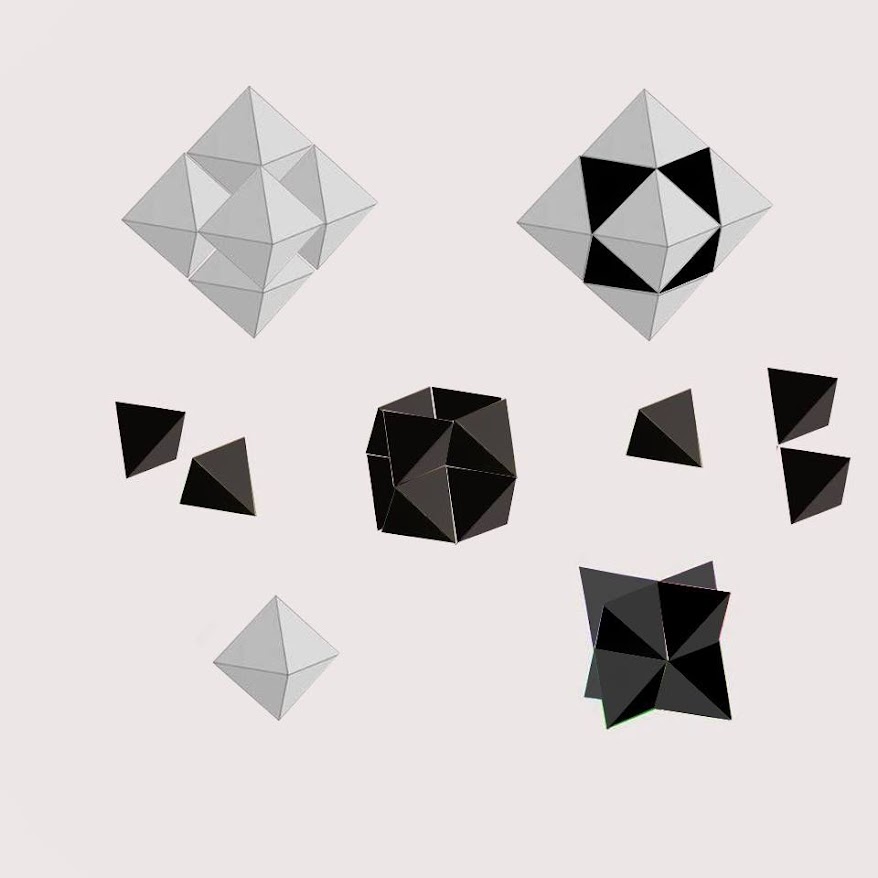
When the eight tetrahedra of the stellated octahedron collapse inward, a truncated cuboctahedron emerges:
- composed of 8 tetrahedra (4 positive, 4 negative)
- forming the first black body at the heart of the Void
The octahedron collapses into itself, the eight tetrahedra merging into a truncated cuboctahedron — Taouret, the first black body (at the center of our galaxy).
Around this structure, six smaller octahedra interlock to form the base regular octahedron, the central structure of our universe.
Three compressions of the primordial Void were required to gather enough elements to form Atum, the first complete cosmic entity.
Atum: The First Complete Geometric Entity
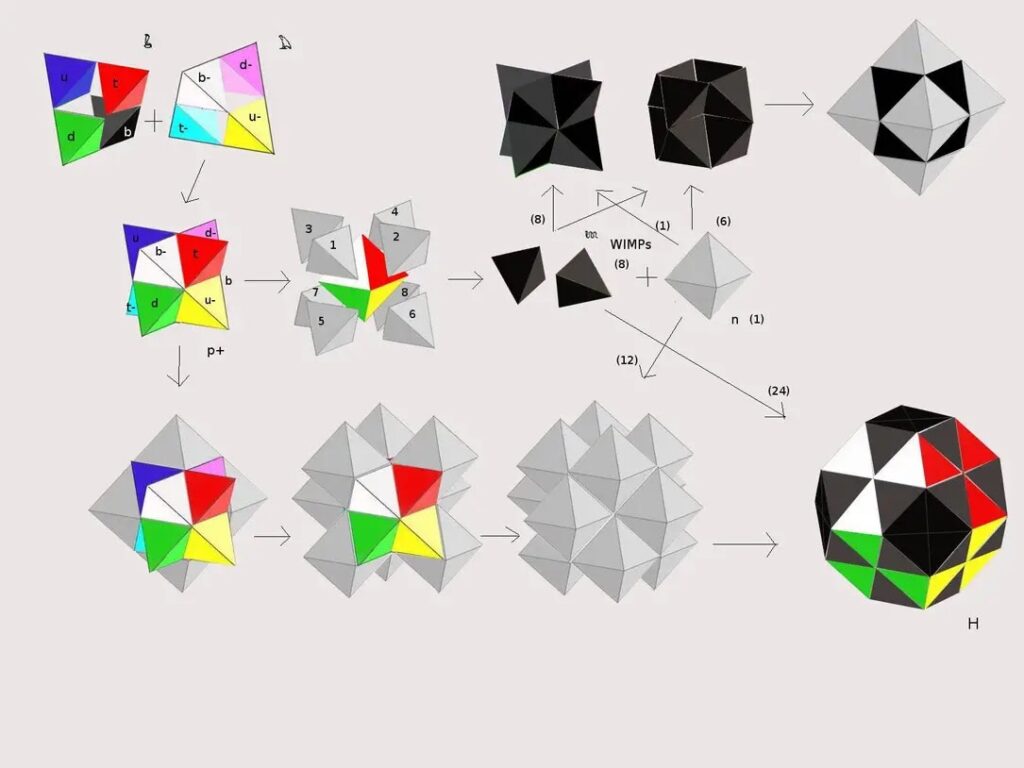
The three compressions of the primordial Void by the infinite Nothingness gave birth to Atum, a complete geometric entity.
Atum takes the perfect geometric form of the truncated octahedron, also known as the Archimedean tetrakaidecahedron.
This structure allows Atum to resist:
- the infinite pressure of the Nothingness
- the eternal present
- and to preserve the instant — life — for as long as possible
All remaining space of the primordial Void, the base octahedron, is compressed between the infinite Nothingness and Atum’s structure, transforming into:
- protium
- helium
- and all elements over time
Each square face of the tetrakaidecahedron is itself truncated, allowing the insertion of an octahedron — a magnetically neutral empty space, a neutron at the atomic level.
This configuration, with six such spaces around the tetrakaidecahedron, corresponds to protium and its six isotopes.
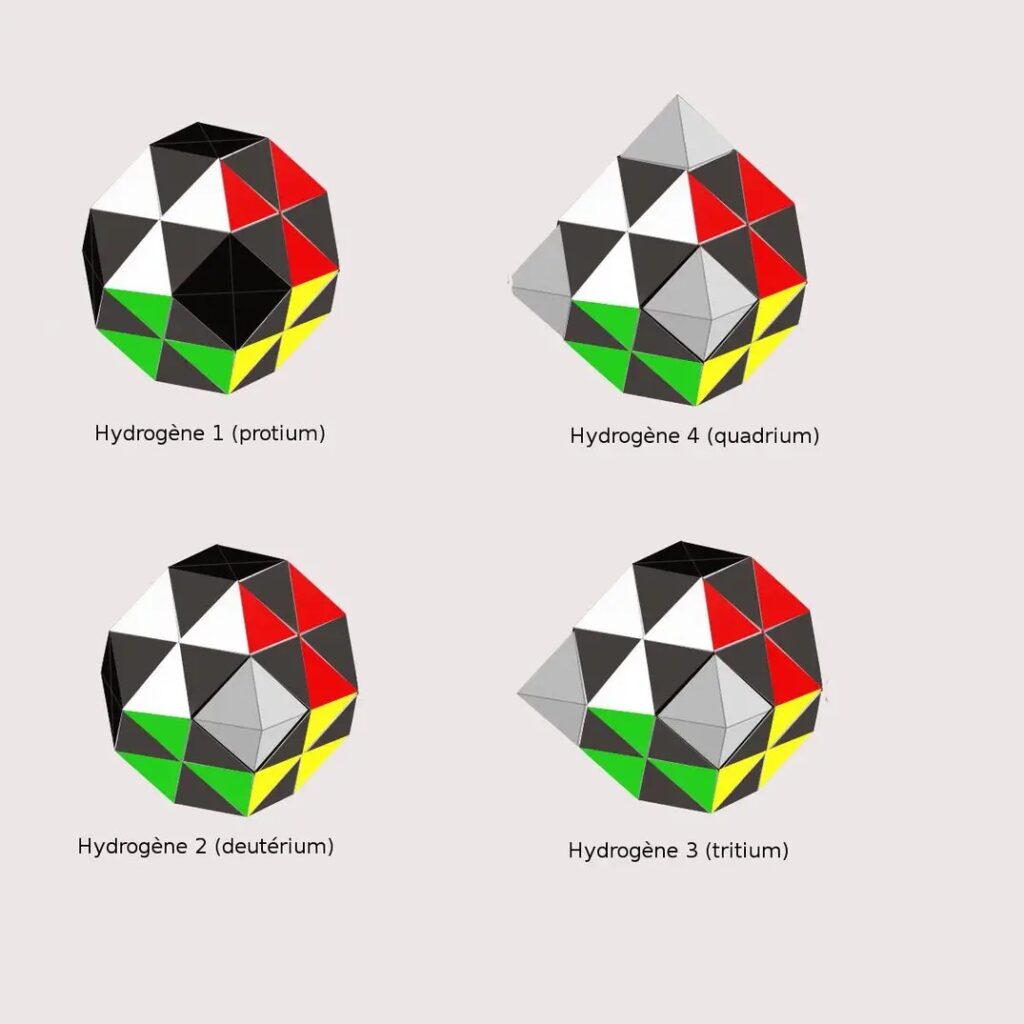
Our solar system mirrors Atum’s structure, bounded by the Oort cloud. Beyond it lies the Nothingness, and far beyond, another solar system.
Each planet forms a pair by size: Mercury–Mars, Venus–Earth, Jupiter–Saturn, Uranus–Neptune. The Sun and planets form the soul of a harmonious solar system.
Helium: Two Interlocked Protium
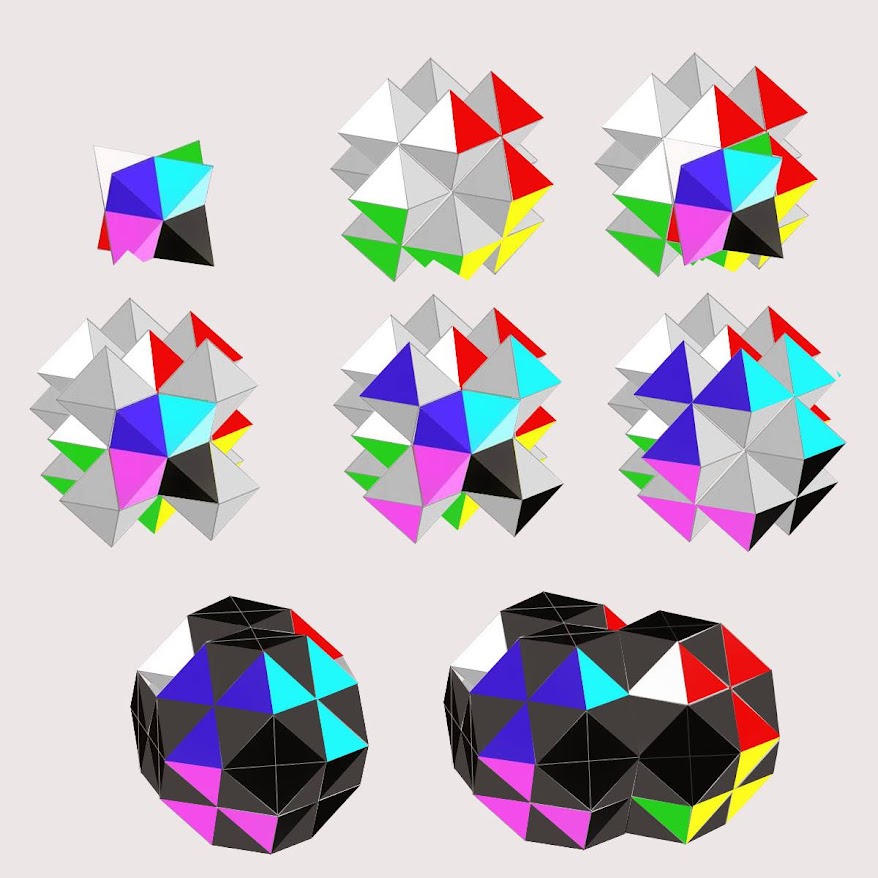
Helium (the diproton), the second fundamental element, emerges from two interlocked protium structures.
These two slightly interwoven truncated octahedra form the diproton, which decays into two protons in 3 × 10⁻²⁷ s.
Eight isotopes of helium are known. Only ³He (two protons, one neutron) and ⁴He (two protons, two neutrons) are stable.
To stabilize the diproton, one or two neutrons must be added.
Lithium: Three Interlocked Protium
Lithium forms from three interlocked protium structures.
Lithium is extremely reactive and never found in pure metallic form in nature. It exists only in ionic compounds and oxidizes rapidly in air and water.
Two stable isotopes exist: ⁶Li and ⁷Li. To stabilize the lithium structure, three or four neutrons must be interlocked.
The Collapse of Atum
Atum, the first cosmic egg/entity, eventually collapses over time. The meaning of life is the struggle against the infinite present — the Nothingness.
The Ba, the stellated octahedron, collapses and returns to the Nothingness.
The twelve protective octahedra — the twelve Ka spirits — are released and, under the pressure of the Nothingness, undergo the same fate as the base octahedron: they collapse three times, forming twelve neutron stars.
These become twelve small Atum around a black body — the first proto‑galaxy, with its twelve “constellations”.
This process continues, leading to the formation of the Milky Way and our solar system.
Magnetic Fields and Universal Forces
Apophis — the serpent is also a quantum of Nothingness, representing dark matter. Apis — the bull symbolizes the magnetic field of the Nothingness. Hathor — the sacred cow embodies the magnetic field of electromagnetism.
The Egyptian royal crowns express these forces:
- The White Crown, Hedjet (symbolizing the Void) represents a three‑dimensional wave.
- The Red Crown, Deshret (symbolizing the Nothingness) expresses the effect of gravitation on the Void. Its spiral stem evokes the Fibonacci sequence, a sign of gravitational compression.
- The Amonian Crown, the crown of Amun — a flat red base topped with two straight feathers (symbolizing dynamic energy) — represents electromagnetism, life.
- The Ourerèt Crown is a white crown with two symmetrical ostrich feathers, the crown of Osiris, a pure energized Void.
- The Atef Crown is an elongated bulb tightened at its tip, from which the solar disk emerges, flanked by two ostrich feathers, all resting on two ram horns (Khnum, gravitation).
- The Hemhem Crown is composed of three Atef crowns placed above ram horns, with two cobras at each end carrying the solar disk. There are eight solar disks in total — a synthesis of the origin of the universe, with the three compressions of the Void and the three neutron stars before Atum.
- The Tjeni Crown consists of two opposing ram horns at the base and two feathers, worn by Sobek, a crocodile that emerges from nowhere and, like the serpent, swallows its prey alive — a mobile black body.
Energetic Waves
The electromagnetic wave is a model used to represent electromagnetic radiation. It is essential to distinguish:
- electromagnetic radiation, the phenomenon itself
- the electromagnetic wave, one representation of that phenomenon
The nature of light was long debated between two opposing theories:
- the wave theory, defended by Christiaan Huygens in the 1670s and later developed by Augustin Fresnel
- the corpuscular theory, supported by Isaac Newton
Huygens studied reflection and refraction, while Fresnel introduced interference and wavelength. The idea that light was a wave led scientists to imagine an invisible propagation medium: the ether.
A major breakthrough came with James Clerk Maxwell. His equations showed that light is an electromagnetic wave and predicted its speed.
At the end of the 19th century, discoveries expanded the electromagnetic spectrum:
- Radio waves, with long wavelengths and low frequencies, were demonstrated by Popov, Hertz, Branly, and Tesla.
- In 1895, Wilhelm Röntgen discovered X‑rays, with very short wavelengths and high frequencies.
In 1901, Max Planck solved the black‑body radiation problem by introducing the idea that energy is emitted in small packets called quanta. In 1905, Albert Einstein explained the photoelectric effect by treating light as a flux of energy — later called photons.
A light wave is an electromagnetic wave whose wavelength falls within the visible spectrum, roughly 400 to 800 nm, corresponding to photon energies of 1.5 to 3 eV. Electromagnetic waves are transverse waves.
The Eight Energetic Waves
The vibrations of the octahedron generate eight types of energetic waves, corresponding to the eight wavelengths of electromagnetism:
- Radio waves — instantaneous communication — > 1 mm (from millimeters to kilometers)
- Microwaves — data and heat — 1 mm to 1 cm
- Infrared — invisible heat — 800 nm to 1 mm
- Visible light — 3 primary colors, 3 secondary, black and white — 400 to 800 nm
- Ultraviolet — energetic light — 10 to 400 nm
- X‑rays — penetrating radiation — 0.01 to 10 nm
- Gamma rays — nuclear energy — < 0.01 nm
- Dark energy — invisible, negative energy
The Electron as a Manifestation of Dark Energy
When the Void is compressed, the dark energy emitted by the proton resonates within the structure and manifests as the electron.
Dark energy, resonating inside this structure, forms a stable electromagnetic wave. This would explain why the electron has:
- very low mass
- but very high energy
Because this dark energy oscillates continuously within this subatomic space.
In summary:
- Everything is wave.
- The electron is not an isolated particle but a concentration of dark energy in the form of a stable electromagnetic wave.
- The electron generates an electric field, which may be a local manifestation of dark energy within the atom.
- The electron’s spin could be an intrinsic oscillation caused by the compression of dark energy, explaining its quantum nature.
- The seven electromagnetic waves (radio, microwave, infrared, visible, ultraviolet, X‑ray, gamma) are positive, while the dark‑energy wave is negatively charged.
In this quasi‑infinite yet finite space, primordial light emerges from the compression of the Void by the infinite Nothingness. It expresses itself through the eight branches of the stellated octahedron, each representing a wavelength.
Dark energy corresponds to the energy resonating within the structure of protium, the electron.
In physics, the electron participates in countless radiations and effects. Its microscopic properties explain:
- electrical conductivity
- thermal conductivity
- the Cherenkov effect
- incandescence
- electromagnetic induction
- luminescence
- magnetism
- electromagnetic radiation
- optical reflection
- the photovoltaic effect
- superconductivity
Consciousness, Subconscious, and the Present Instant
Temporal perception arises from a balance between different speeds of thought:
- The subconscious, the Ba soul, faster, anticipates and acts as a potential future.
- The conscious mind, the Ka spirit, slower, synthesizes past experiences.
Together, they form the present instant, life itself, inscribed within the eternal and static present time — Heqet seated on the Shen ring, an empty cartouche symbolizing timelessness.
The Emergence of Earth: Horus
Earth is first symbolized by Osiris, a living cosmic entity representing a giant geode: a central Void surrounded by minerals and water, like a cosmic coconut.
But this primordial structure was shattered when a comet — Isis — collided with it. This impact caused the death of Osiris, releasing water and gases in a cosmic eruption.
From this disintegration were born:
- Earth‑Horus, with its first continent (Geb),
- an ocean and the beginnings of an atmosphere (Nut),
- and, through accretion, our Moon (Seth), marking the first celestial union.
Thoth, in his lunar aspect, changed the calendar from 360 to 365 days and created tides and seasons — a new rhythm for the present instant.
Horus, son of Osiris and Isis, embodies this new Earth, both heir and transformation of its origin. Represented with a falcon’s head, Horus symbolizes Earth’s orbit around the Sun, itself depicted as another falcon bearing the solar disk.
Horus is also shown as a falcon that circles the sky and lays eggs — a reminder that the egg came before the chicken.
Earth, like a fractured geode held together by Khnum (gravitation) and Heh (infinite time), through Heka (the magic of time), lays eggs as well:
- first mineral “eggs” (geodes),
- then biological seeds,
- from bacteria to plants, animals, and humans, depending on environmental evolution and atmospheric conditions.
When a geode is cut open, it releases a central liquid and reveals a Void surrounded by dazzling minerals. Thus Earth‑Horus bears witness to mineral life, a form of life unfolding on timescales far longer than biological life.
As long as a geode remains intact, it is “alive.” Horus, despite cosmic upheavals, survives — carrying the scars of its cosmic history.
Over time, the oceans and atmosphere (Nut) stabilized, providing a new medium where biological life could emerge. Water, with its tetrahedral structure, and oxygen and carbon, with their octahedral structures, became the foundation of biological life — just as the Nothingness (Nun) is the foundation of atomic and cosmic life.
This new structure, Nut, allowed the emergence of biological seeds: plants, bacteria, insects, animals, and eventually Homo sapiens, born of Horus, mirroring the universal cycle — an egg (ovum) and a comet (spermatozoon), arranged in four pairs.
Four pairs — bacteria, ferns, orchids, elephants or lions — would be distributed across all continents and biological levels to preserve diversity.
The Earth’s core, called the “Earth seed,” would be a liquid cosmic seed, powered by cold fusion, where heat gradually emerges from the “death” of minerals. This seed, like a geode or a nut with its shell, symbolizes life at the heart of Earth, protected by a solid crust.
The Intervention of Amun and the Creation of Ma’at
Re, the Sun, impressed by the creation of Horus and by the potential of Homo sapiens, sends one of his sons — Amun, Amun‑Min — to Earth to awaken humanity and bring wisdom.
Amun, in an act of sacrifice, transmits Shu (the breath of life) to Tefnut, a Black woman from Ethiopia chosen for her symbolic depth, representing the infinite Nothingness. This union gives birth to Sekhmet, a manifestation of pain and transformation, who becomes Ma’at. This marks the second celestial union, a union of Earth and Sky.
“Then Atum said: ‘This is my daughter, the living one, Tefnut; she is with her brother Shu. The name of Shu is Ankh. The name of Tefnut is Ma’at.’” — Coffin Texts, ch. 80
Tefnut, known as “The Distant One” in mythological texts, is the daughter of the Sun god Re and a goddess associated with moisture and rain, symbolizing an earthly essence.
After receiving Shu, the breath of life from Amun, she flees into the Nubian desert. There, she transforms into a fierce lioness, embodying forces of chaos and destruction. In this aspect — often associated with Sekhmet — she becomes the guardian of the laws of Ma’at, watching over justice and cosmic order, while reminding humanity of the necessity to respect universal principles.
Guided by the light of the Moon, embodied by Thoth, Tefnut is found and calmed. Reassured by his wise and benevolent words, she returns to her beneficial aspect and restores harmony within the cosmos.
Ma’at, goddess of universal wisdom, reveals the secrets of the universe: its origin, the origin of life, and her knowledge of geometry, alchemy, medicine, number science, and the art of geopolymers — laying the foundations of civilization.
She initiates the construction of:
- the Nubian pyramids (built with golden proportions),
- the step pyramids (symbols of successive compressions of empty space),
- the temples (repositories of her knowledge),
- and finally the Giza plateau, where the mythical pyramids stand as testimony to a cosmic knowledge lost, hidden, or diverted by others.
The smooth pyramids are designed so that their reflection in surrounding water forms a perfect octahedron, symbol of the primordial Void shaped by the Nothingness.
The three great pyramids represent the belt of Orion as it stood above them during construction, and the Sphinx faces the constellation of Leo — pointing to a date around 12,000 years ago (the Orion correlation).
The solar boat found near the pyramid of Khufu is a true masterpiece of simple yet highly technical craftsmanship, derived from divine knowledge.
The black solar boat symbolizes the Nothingness and the infinite present time upon which we drift.
Ma’at travels by sea and by air, leaving behind pyramids and temples, allowing each people to transmit the laws of the universe in its own way.
Humanity’s mission is to protect Horus, our nurturing Earth.
In China, hundreds of pyramids and tumuli symbolize the opposing forces of the Nothingness, represented by the two lions of Fo: one pressing a sphere adorned with the Flower of Life, the other pressing a lion cub — symbolizing creation and destruction under the pressure of the Nothingness.
The Nothingness also takes the form of a serpent, a dragon, or a cube.
In South America, the Maya and Inca evoke the jaguar, the feathered serpent, and step pyramids, with temples dedicated to the Sun and the Moon. Colossal sculptures, such as the Olmec heads, may represent Ma’at.
She is said to have lived 1,000 years. Her union with Amun rendered her sterile — a theme echoed in Indian temples where numerous nude scenes may represent attempts to conceive. On Easter Island, known as Mak Mak, she is said to have descended from the sky.
The Cycle of the Nothingness — “Big Brunch”
The idea of an infinite universe in expansion remains theoretically and observationally uncertain, due to poorly defined limits and imprecise astronomical measurements. This leaves open the possibility of a finite universe.
Contrary to the idea of an expanding universe, I propose a cycle in which the primordial Void slowly collapses in stages, shrinking the dimensions of everything that exists.
This creates the illusion that objects are moving away from each other, but in reality, everything is gradually returning to the Nothingness.
This process, initiated by the collapse of Atum, would have formed:
- proto‑galaxies,
- then stars,
- then galaxies,
up to the present day.
In the end, the universe dissolves completely into the Nothingness.
© 2026 ADAMS‑J‑AI — Legal Notice